Washingtons' Long Island vacation house
Leave the World BehindThe Washingtons' Long Island vacation house first appears as an appealingly self-contained retreat: a white-painted brick home equipped to make comfort seem reliable and privacy seem complete. But its remoteness and carefully managed amenities give that promise a limit. When a blackout sends G. H. and Ruth from Manhattan to the house, the same place that seemed removed from danger becomes a provisional shelter in a crisis whose scale the people inside cannot yet establish.
Setting and Arrival
Amanda finds the rental on Airbnb, where its listing calls it “The Ultimate Escape.” The description promises that guests can step inside and leave the world behind, a pitch Amanda appreciates even as the house’s distance from ordinary connections becomes evident. On the drive, a gooseneck trailer leads them along a rural route; once it turns off, their GPS loses track of their location. Amanda has copied directions into a notebook, so the family continues by following her handwritten sequence of turns rather than relying on satellites.
The house stands amid farmland, near enough to suggest the ocean but not close enough for the family to afford a stay beside it. A sculpted hedgerow obscures it from view. The front yard is enclosed by a white picket fence, while a separate wood-and-wire fence surrounds the pool. These boundaries distinguish the house from its surroundings and help make it feel private, yet they also reflect practical concerns: the pool is fenced partly for insurance and partly because deer might wander in and drown.
A Designed Retreat
The building’s appearance is defined by contradiction. Its brick has been painted white, transforming the material’s red; the house looks both old and new, solid and light. The narrative connects that combination to a broader desire for possessions that embody opposing qualities. The house is not merely a shelter but a polished image of refuge, shaped to feel substantial without seeming heavy or remote from modern comfort.
Inside, the quiet registers as evidence of expensive systems working properly. Central air-conditioning, a high-end refrigerator, synchronized digital displays, and exterior lights programmed to turn on at a set hour make the house seem able to maintain itself. Its wide-plank floors come from an old cotton mill in Utica and are fitted so smoothly that they do not creak. Clean windows, prepared blinds, a lowered thermostat, and recently vacuumed furniture show the work of people who have made the rental ready for its guests. The impression is of a home that barely needs people in order to function.
Amanda finds that the photographs on the listing have accurately promised what the house provides. Pendant lamps hang above an oak table; a gray marble island offers space for imagined domestic work; a double sink looks out toward the pool; and a copper faucet beside the stove allows a pot to be filled in place. These details suggest owners wealthy enough to anticipate practical needs. Amanda imagines herself washing dishes while Clay grills outside and watches the children play Marco Polo. For the moment, the house accommodates an ordinary family routine as easily as it displays its amenities.
Access, Boundaries, and Dependence
Arrival depends on instructions Amanda saved before the family lost phone service. She checks her phone, finds no signal, and recalls the lockbox location and its four-digit code: it is on the fence beside the pool heater, and the key inside opens the side door. The contrast between a meticulously arranged rental and the absence of a network connection is immediate. Access is possible because Amanda planned ahead, not because the house can call up missing information from the outside world.
The pool enclosure makes the house’s relation to the surrounding landscape especially clear. Its fence protects a human amenity, but the owners also anticipate deer straying into an attractive hazard while the property stands empty. The home’s boundaries therefore express both comfort and vulnerability: the pool is made safer through design, while the landscape beyond the fence remains capable of bringing animals into contact with it. Rural quiet and urban disconnection are not the same thing, even when the family initially treats distance from the city as part of the attraction.
From Rental to Shelter
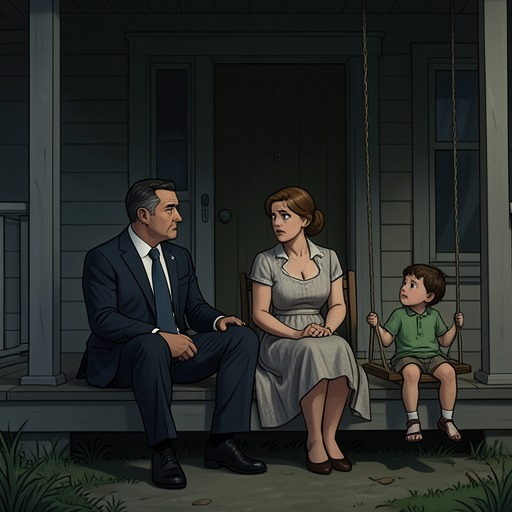
The house’s meaning changes when G. H. and Ruth arrive after seeing the lights go out in Manhattan. Amanda questions why they drove so far; G. H. explains that the roads are familiar and that he acted without fully understanding his own decision. Ruth is more direct: they thought they might stay. Their arrival turns the rental from a private vacation setting into shared shelter, and the house’s capacity to contain more than one household becomes a matter of immediate importance.
Clay proposes that they remain there for the night and work out what is happening the next day. His suggestion rests on a stark contrast: New York City has lost power, while the house still has electricity, even though television and the internet are unavailable. The retreat’s comforts thus acquire a practical use, but they do not resolve the uncertainty outside it. Amanda considers whether the group should gather water, batteries, candles, and other supplies; Ruth raises the possibility that the blackout could signal something larger. The house can offer a place to wait, not an explanation.
The Promise of Safety
The knock at the door exposes the tension built into the house’s presentation. The family is in a rural home whose location is obscure even to its GPS, yet someone has found it. The narrative links the house’s white-painted brick to the familiar story of the little pig choosing brick for safety, but the comparison cannot guarantee that this refuge will keep danger out. A building may be solid, quiet, and well equipped while remaining exposed to events beyond its walls.
That gap between design and security gives the house its significance. At first, the listing’s promise of escape seems compatible with the family’s vacation routines and the owners’ carefully maintained systems. After the blackout, however, electricity, internet access, and reliable information no longer coincide: the house has power, but the broader situation remains unknown. Its comforts are real, and its isolation is real too. The vacation house becomes a shelter precisely when its promise of leaving the world behind can no longer be trusted.